

719-357-7591
Automated construction with concrete yields structures that are built to stand the test of time. Precision
and quality construction are the guiding principles for our work. Read more about our materials and construction below.

A modular standing gantry design optimized for concrete 3D Printing.

Resistant to:
• Earthquakes
• Wild Fires
• Flooding
• Hurricanes

• Lasts 2-3 times longer than other building materials
• Low Maintenance
• Continued Energy Performance
• Continued Acoustic Performance

Not susceptible to:
• Termites
• Dryrot
• Mold/Mildew
• Vermin
With the StructureBot home building system, you can build strong, beautiful concrete homes with all the added benefits like energy efficiency, safety, and quieting outside noise.
Strength
Concrete is simply a better way to build a better home.
Safe and Sound
The threat of natural disasters affects nearly every area of the planet in the form of hurricanes, tornadoes, wild fires, floods or earthquakes. As seen in the aftermath of many disasters, families were safer in a home constructed with concrete walls. Concrete is consistently chosen for the construction of disaster shelters and military bunkers due to its properties of high compressive strength, durability, and impact resistance.
The concrete used in 3D Concrete Construction is typically 3,000 to 6,000 PSI and can be used for walls, footers and foundations and even roofs. StructureBot has partnered with industry leader Quikrete to provide top quality 3D Printing mortars. This formulation has been successfully used on projects across the country.
Furthermore, with the addition of aggregates into the mix, the material cost can be reduced even further in comparison to other building materials while maintaining high compressive strength.
StructureBot's Series 2 printer is capable of printing concrete walls of any thickness. These walls are typically engineered with integrated reinforcing wall columns and pilasters. The walls systems offer design flexibility because the columns are usually hidden in the wall. See the drawing below and notice the vertical column cavity and rebar reinforcement inside the cavity. This cavity or "fill cell" will be filled with a monolithic pour of concrete.
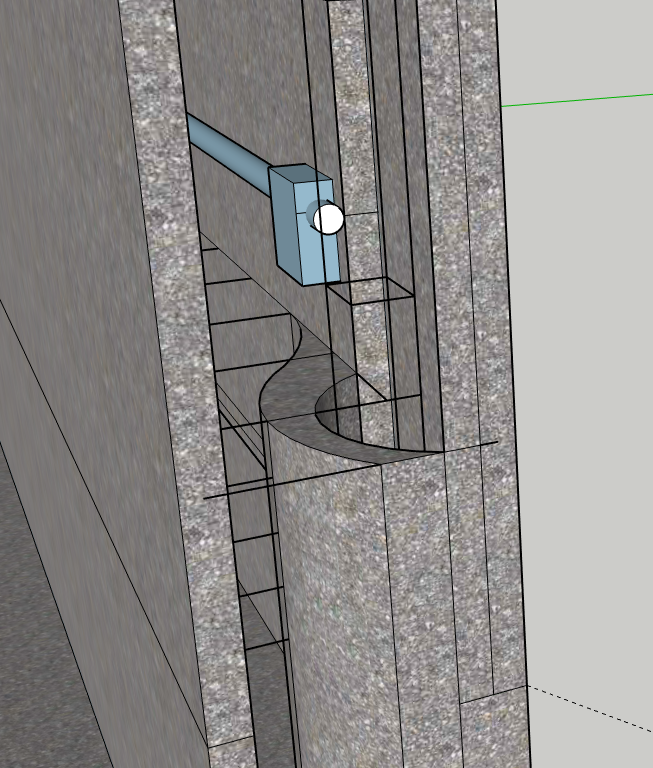
Image 1 - An integrated fill cell cutaway. The semi-round column contains a vertical rebar reinforcement structure. The column is isolated from the exterior side of the wall to reduce thermal bridging. The interior and exterior sides of the wall are connected and stabilized via ladder wire and occasional connective columns.
A Solid Investment
A home is usually the largest single investment of most people's lives. If that home is constructed with concrete walls and foundation, it's protected from the structural damage that could threaten that investment. Lower maintenance costs, insurance costs, and energy costs also contribute to the overall value of the investment in a concrete home. The stability of the investment is also attractive for investors or prospective buyers who may be worried about hidden mold or rot contributing to structural issues.
A concrete house is a solid investment for families both in terms of value and safety.
The Quiet Comfort Of Home
Aside from being stronger and more durable, the mass of a concrete wall provides a high level of sound-proofing. The peace and quiet of a concrete home can be an incredible benefit to those living in the loud city environment or near a highway.
The many added benefits are not all seen at first glance, but are certainly worth considering.
Contact us to talk about a StructureBot Series 2 printer and our related services.
We're a team of engineering and construction professionals dedicated to improving construction methods.
See teamHow much can 3D Printing save over traditional construction methods?
The answer to this question has 4 parts: savings in time, materials, labor and safety.
Time saved depends on the full extent to which the technology is utilized, but the short answer is that a job the commonly takes 9 mounts could be reduced to one month (the same machine can do foundation, floor, walls, and roof in fairly quick succession). Conservatively we could easily say 50%, making the building available much sooner.
The amount of materials saved is considerable because we eliminate almost all material waste. There's no need to have a roll-off dumpster full of waste as the end of a job. Further, we're using a more cost effective material. We've calculated a material cost savings of 30%, and that was before lumber prices went crazy.
Labor savings is fairly easy to consider. An experienced team of 2 is all that's required to setup and to run the printer. With the printer running at full capacity, an 8 foot high print can be completed in a week (1 day setup, 3 days printing, 1 day takedown). Compare that to a team of 4 framing for a week, to also come out around 50% savings. And there's no doubt that today's young people would rather control a robot than swing a hammer. This increases the appeal to attract labor.
Jobsite accidents are one of the most costly incidents in the construction industry. With Concrete 3D Printing, the robot is doing the dangerous work, and the laborers are controlling it on the side. The laborers aren't using screw guns or nail guns. The laborers aren't lifting trusses or removing formwork. Reducing accidents not only keeps workers safe, but also opens the doors to a greater range of age and for women to be more involved at the construction site. With the robot doing the dangerous work, we're confident that's a reduction of 50%.
To sum up, you can expect 30%-50% savings in 4 key areas.
What's the largest building you can print with this printer?
The printer has a modular design, so you can add on more length, width and height. We've recently increased the maximum length to 100 ft. The maximum height is 30 ft and the maximum width is currently set at 30 ft for our lightweight X-axis.
However, the largest building you can print can be much bigger than that because you can move the printer to print the building in sections and connect the sections. In fact, to keep the concrete layers adhering well to each other, it's optimum to keep prints to a maximum of 30 ft x 30 ft per day.


