

719-357-7591
Automated construction with concrete 3D Printing yields structures 30% faster with just a crew of 2 or 3. Precision and quality construction are the guiding principles for our work. Read more about our time and labor savings below.

A modular standing gantry design optimized for concrete 3D Printing.
• Automated Mixing and Pumping
• Elements can be placed as the walls come up
• Minimal Exterior Work
• Quick Time to Dried-In

• Walls printed in 3 days with 3 laborers
• One machine for many applications one after another (footer, slab, walls, roof)
• Fast Setup and Disassembly
• Fully Mobile Solution

• Reduce Costly Errors
• Reliable Consistent Quality
• Meet Customer Expectations
With the StructureBot home building system, you can build strong, beautiful homes 30% faster with a 3D Construction Printer.
Time and Labor Savings
The time savings can be achieved in various processes. But the short answer is that a job the commonly takes 9 months could be reduced to one month because the same machine can do foundation, floor, walls, and roof in fairly quick succession.
Let's compare traditional framing of walls to 3D Printing of walls. For 3D Printing, an experienced team of 2-3 is all that's required to setup and to run the printer. With the printer running at full capacity, a 1,000 sq ft house with 8 foot high walls can be completed in 3 days of printing. Compare that to a team of 4 framing for a week. And there's no doubt that today's young people would rather control a robot than swing a hammer. This increases the appeal of your business to attract labor.
Savings in Lost Time Accidents
Jobsite accidents are one of the most costly incidents in the construction industry. With Concrete 3D Printing, the robot is doing the dangerous work, and the laborers are controlling it on the side. The laborers don't use screw guns or nail guns. The laborers aren't lifting trusses or removing formwork. Reducing accidents not only keeps workers safe, but also opens the doors to a greater range of ages and allows women to be more involved at the construction site. With the robot doing the dangerous work, we're confident that's a big reduction in accidents.
95% Reduction in Waste
The amount of materials saved is considerable because we eliminate almost all material waste. There's no need to have a roll-off dumpster full of waste at the end of a job and the time taken to fill that dumpster has been saved as well.
Reduction in Material Cost and Handling
Concrete is a more cost-effective material. We calculated a material cost savings of 30%, and that was before lumber prices went crazy. But on top of that, the material is mixed and pumped by the automated system.
To sum up, you can expect 30%-40% savings in the 4 key areas above.
Here's a general timeline analysis:
Pre-construction period. Before starting construction, you will likely have to pull permits, finalize architectural plans and get financing sorted out. This can take one to two months — or longer. If the customer opts for one of StructureBot's included designs, these can be quickly customized for the project.
Preparing the lot and laying the foundation. This includes clearing out debris and trees, leveling out the lot and pouring the foundation. A month is about average for this step. StructureBot can speed this step by printing the foundation and pouring the slab.
Framing the house and building the roof. Framing usually takes about a month, but bad weather can delay things. Once the roof is up — usually a couple of weeks — weather is generally less of a concern. With StructureBot, the walls can be printed immediately after the foundation or stem wall. The roof can be poured using ICF roof formwork immediately following the walls going up. This can move your timeline forward dramatically!
At this stage, pre-fabricated interior wall sections may be placed in the interior. These sections may have interior wiring and plumbing already installed. Pre-fabrication saves additional time and these sections can allow for easier interior remodeling.
Siding, wiring and plumbing. Workers will finish the outside of the house and get the plumbing, electrical, and HVAC started, which takes about one or two months. However, with the StructureBot system, NO siding is required. Much of the conduit for plumbing and electrical boxes were already placed in the walls when they were printed, making the trade's jobs much faster. For many homes NO exterior paint is used either, but often a sealer is applied.
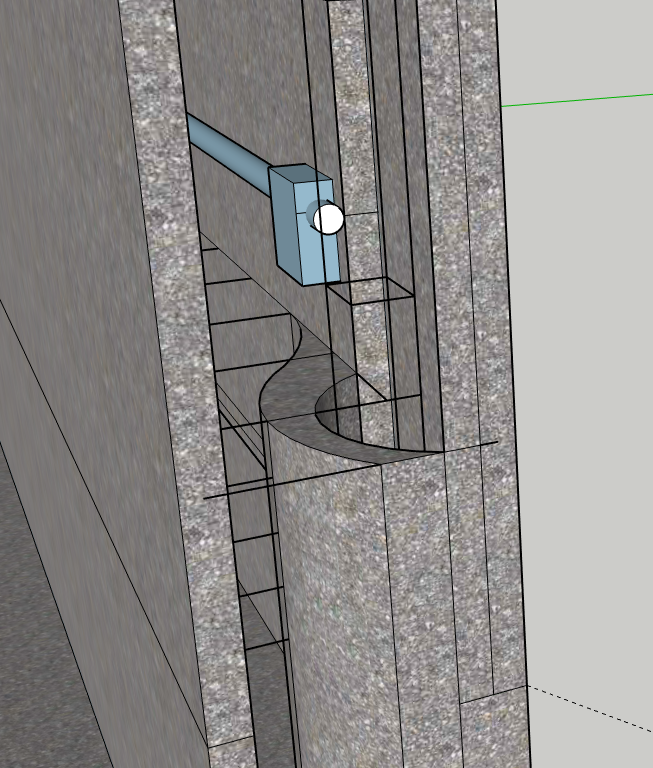
Image 1 - An integrated fill cell cutaway. The semi-round column contains a vertical rebar reinforcement structure. The column is isolated from the exterior side of the wall to reduce thermal bridging. The interior and exterior sides of the wall are connected and stabilized via ladder wire and occasional connective columns.
Interior finishing. Traditionally, the drywall and most of the carpentry would be completed at this step. Expect about two months. But you guessed it, NO drywall is required for 3D Printed walls. This represents significant time and cost savings!
Finish work. In the final two months, contractors install the floors, paint and finish the plumbing and electrical work. The floors would have already been done when the slab was poured, and less painting is required.
Inspections. The timing of some wiring inspections may need to be modified to show how the conduit is placed in the wall. Video may also be captured during the process to show the placement of the conduit in the walls.
Contact us to talk about a StructureBot Series 2 printer and our related services.
We're a team of engineering and construction professionals dedicated to improving construction methods.
See team


